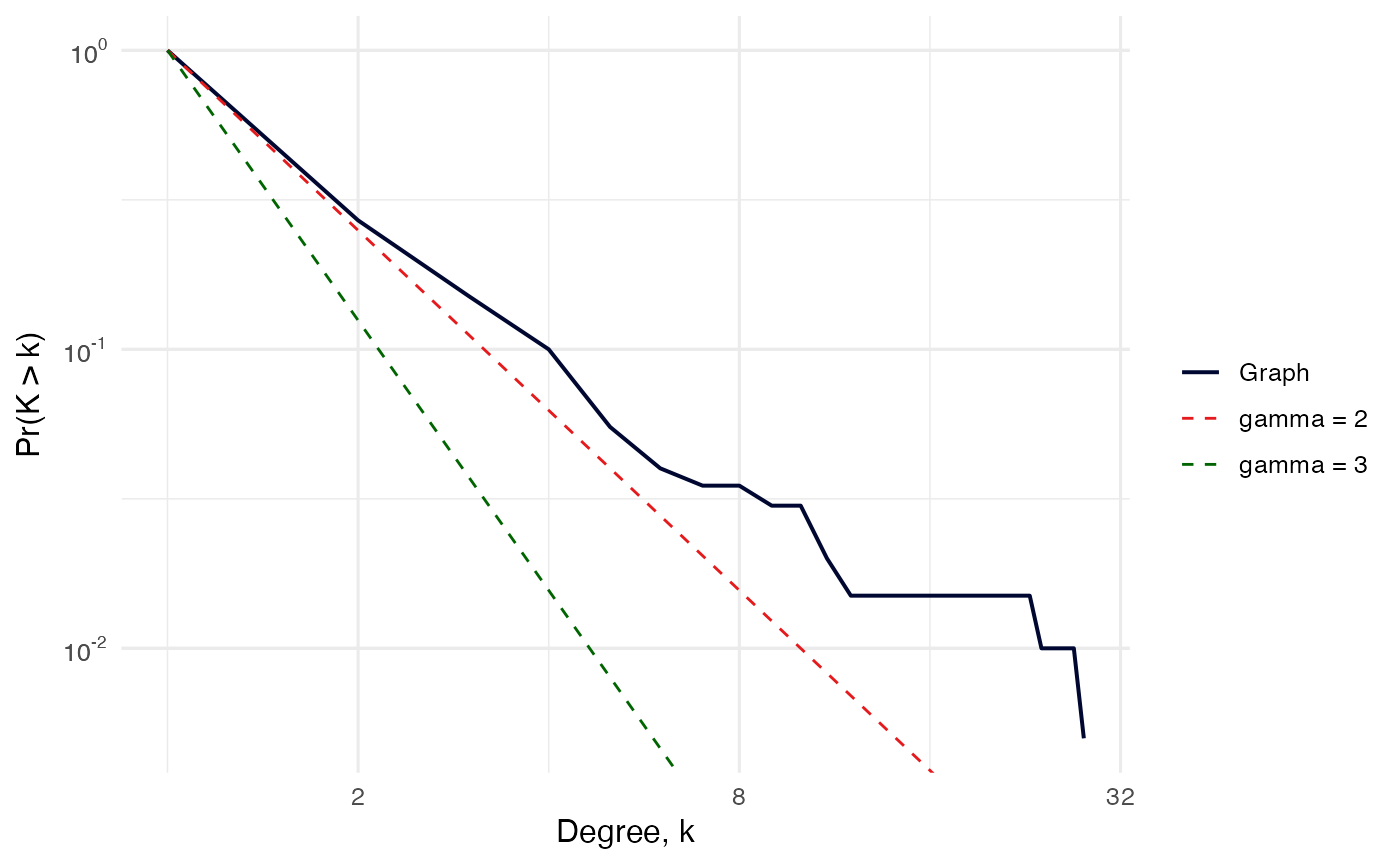
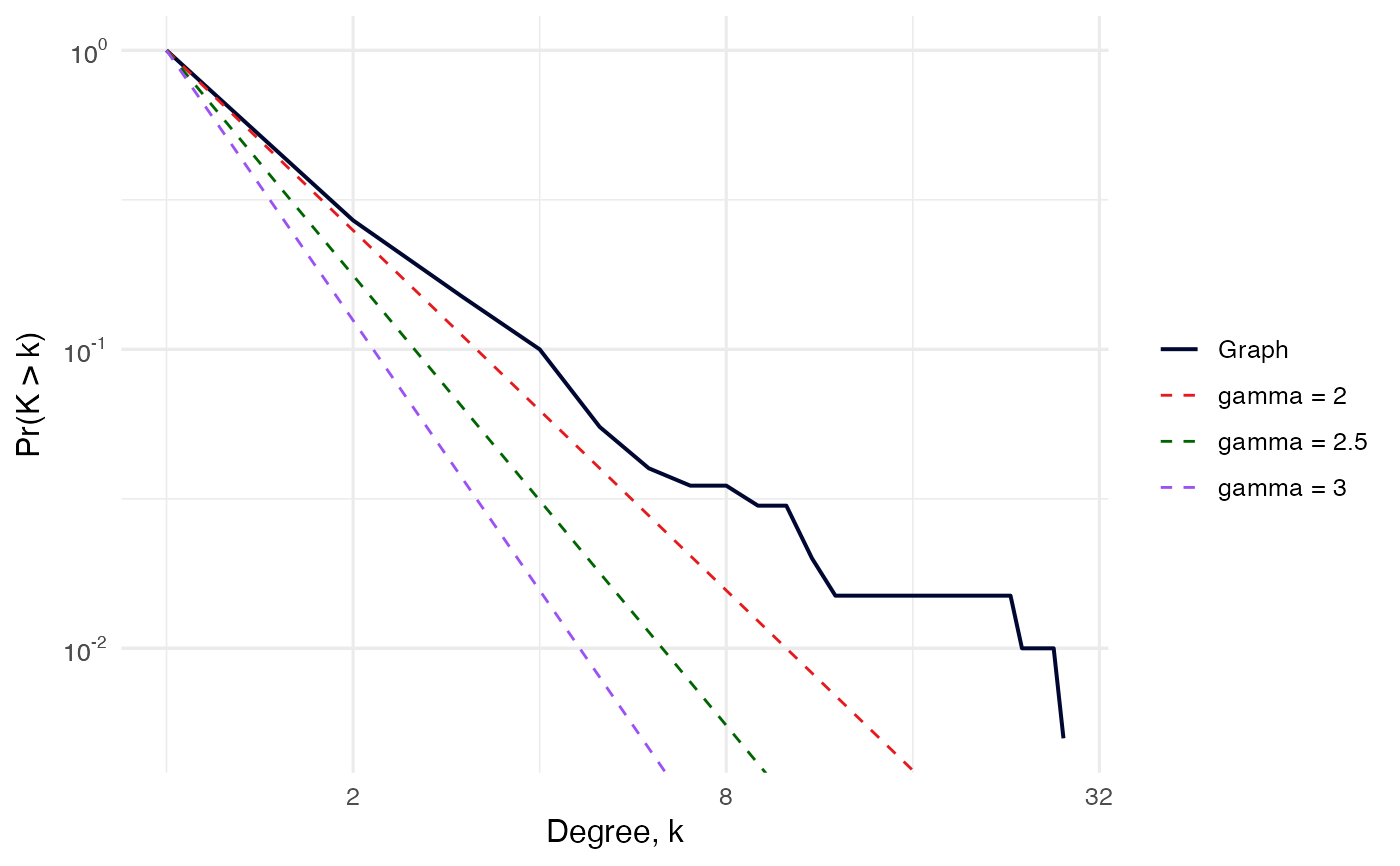
This function plots the complementary cumulative distribution function (CCDF) of node degrees in a network and optionally overlays power-law reference curves.
Arguments
- graph
An
igraphobject representing the network to analyze or a data frame containing a symbolic edge list in the first two columns. Additional columns are considered as edge attributes.- keep_direction
Logical. Only for directed graphs. If
TRUE, CCDF curves are drawn for 'in'-degree, 'out'-degree, and 'all'-degree distributions.FALSEto ignore directionality.- remove_singles
Logical. If
TRUE, nodes with degree 0 are removed from the graph before computing the CCDF. Default isFALSE.- show_PL
Logical. If
TRUE, overlays theoretical power-law reference lines of the form \(P(K > k) \sim k^{-\gamma}\). Default isTRUE.- PL_exponents
Numeric vector. The \(\gamma\) exponents for the power-law curves. Default is
c(2, 3).- colors
Optional character vector. Custom colors for the graph curve and power-law lines. If
NULL, default colors are used.- label.size
Numeric. Font size for axis labels and theme. Passed to
theme_minimal.- weights
Optional edge weights:
NULL(default) to plot the degree distribution, or the name of an edge attribute / a numeric vector of lengthigraph::ecount(graph)to plot the vertex strength distribution instead. See netkit-weights.- weight_type
Either
"strength"(default) or"distance". See netkit-weights.
Edge weights
Functions that can use edge weights take two arguments:
weightsNULL(the default) to ignore edge weights; the name of an edge attribute, such as"weight"; or a numeric vector with one value per edge, inigraph::E(graph)order.weight_type"strength"(the default) if a larger value means a more tightly connected pair – confidence scores, correlations, co-expression, read counts, interaction scores."distance"if a larger value means further apart – costs, dissimilarities, reaction times.
Declaring which you have is not bookkeeping. igraph reads the weight
attribute implicitly and gives it opposite meanings in different functions:
a cost in igraph::betweenness(), igraph::distances(),
igraph::diameter() and igraph::mean_distance(), but a strength in
igraph::cluster_louvain() and the other community detection algorithms.
Attaching a confidence score and letting that happen implicitly therefore
inverts every path-based metric – a high-confidence interaction is treated as
a long distance – while community detection reads the same numbers the way
you intended.
netkit resolves weights and weight_type once per call and derives both a
strength and a distance vector from them, so each metric receives the one it
needs. A "strength" is converted to a distance by reciprocal
(\(1/w\)); a "distance" is converted to a strength by reflection
(\(\max(w) - w + \min(w)\)), which keeps a zero distance finite.